Wednesday, January 04, 2006

The Magic that is π


Unless you've had some sort of high school geometry "PI"-- or the symbol π as its referred to in math & science--probably seems like a meaningless concept. Little do most of us realize how important PI is to our existence. But before I go any further, here is a π refresher for all of you who slept through 10th grade math. π is a mathematical constant that represents the ratio of a circle's circumference to its diameter. If you know the distance around a circle, you can find the diameter as long as you have π. Or if you take the circumference of the circle and divide it by its diameter you will ALWAYS get π. It doesn't matter how big the circle is, it works every time whether it’s a star that's bigger than our own or an everyday basketball. Pretty slick, huh?

So what...what do I care?

Here goes my geekatude at full throttle so get ready. π is 3.1415926535....and so on. The decimal is non-repeating (so far). It also cannot be expressed as an exact fraction, its only an approximation. So technically, you can never create a "perfect" circle. However, over the centuries, mathematicians have been trying to find out a more exact expression for PI. So far, π has been calculated to 1,241,100,000,000 (trillion) decimal places. This was done by computer scientist Yasumasa Kanada and his coworkers at the University of Tokyo Information Technology Center back in 2002 using this formula. (Click here if you want the first 10,000 to impress your friends)


Looks pretty straightforward with all of those "arc tan" thingies and of course the plus and minus signs that we all recognize. Hard to believe that you need a supercomputer that can carry out the 2 trillion operations per second to achieve all of those digits. To put that into perspective, if you counted to one trillion saying a number each second, it would take you 31,000 years to finish! If someone started during the last ice-age, they would still be counting.

To put it bluntly, Mr. Kanada turned it on and let it crank out numbers for a very long time. By the way, in 1999, Yasumasa Kanada worked with researchers to calculate 206,158,430,000 digits of π landing him and his team in the Guinness Book of World's Record for what could possibly be the most academic/nerdiest pursuit of all time. I can't imagine why they got that dubious award. They simply didn't do enough nerdy things to warrant it. (Maybe they should try performing long division on random numbers for a week without sleeping. That will no doubt cinch it for them

Why you ask--for the love of all that is normal--do they not have better things to do with their time? The reason for this is simply to test computer power. Someone very soon, no doubt Mr. Kanada again, will eclipse this record and get nothing for it.

In case you are wondering and I know you are, the 1,241,100,000,000th decimal digit of pi (not counting the initial digit, 3) is 5. Chicks dig a dude who knows this.

Seriously, we all need to pay homage to π. Not because it's a non-repeating (so far), irrational number (a number that can't be expressed as a fraction)--although that pretty impressive too--but because without π, circles or variations thereof would be very hard to come by. Just look around the room for a minute and check out all of the perfectly rounded items. Wheels on your chair, electrical cords, fans, computer CDs, gears on your car or watch or even pendulum clocks just to name a few. Now imagine everything in your life without rounded edges. Sure, curvature would still exist in nature such as plants, animals, humans, etc. But every manmade object of a circular nature requiring exact measurements would be grossly inaccurate. Bridges would be created with asymmetric curvature thus affecting its ability to hold weight. Every time a sea of vehicles would drive on it or a strong wind would blow through its support beams causing the bridge to resonate at an unwanted frequency, its structural integrity would be compromised thus potentially causing the bridge to collapse. Do you like π a little more?

Pi is fundamental to the way in which our universe functions; practically everything is dependent on π at some basic level: light, sound, energy, gravity, electromagnetic fields, the movements of the planets and matter itself. Without π, our understanding of this stuff would be nil. To engineers--who have in essence--designed and created our infrastructure such as roads, bridges, sewer systems, plumbing, and etc-- π is an invaluable number. Imagine a hospital without an MRI or a CT Scan Machine? In other words, without π we'd still be in the dark ages.

I'm not asking all of you to become nerdy, pocket-protector computer geeks, I just think we all, as contributing members of society, need to step back and think about the little things that make life, as we know it, much easier. One of those "some things" is π.

π sounding like your next best friend? I thought so.

Tuesday, January 03, 2006

Checkout Chaos

Checkout Chaos

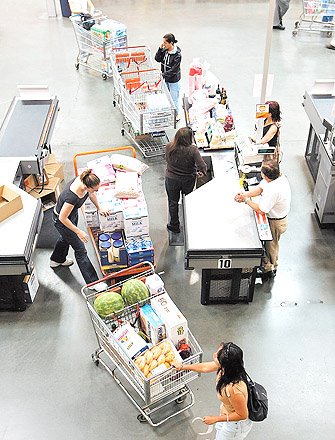
Ever since I've been a kid, I've dreaded grocery shopping. Don't get me wrong, I cherished that time with either with my dad or mom. But the hum-drum pace of trudging through 18 isles looking for romane noodles the clueless high school inventory clerk stacked in the wrong spot isn't my idea of world-class usage of free time.

The real reason why the evils of grocery shopping irritate me don't reside in the act of shopping itself but from the proverbial explanation point of the entire process:

Yep, trading currency for the goods in the checkout line.

While waiting in the line to the cash register, we all have our ways of passing the time when the line is long. Maybe it’s reading the tabloids or paroozing through the endless shelves of gum and assorted candy looking for that quick pick-me-up. Shoppers don't


care what you do as long as you follow what I like to refer as "Checkout Etiquette". Invariably,
the first rule in the book is violated every time I step into the line. Wouldn't you know it, it’s always me who gets behind an individual who can't comprehend the novel idea of having money close at hand so as not to "upset the applecart".

Allow me to paint this chaotic picture for you: It’s usually an older individual who is female-not always but most of the time--who has lost some mental dexterity in the mental math department.
The clerk scans the last item and hits the total button which displays the final amount on the screen for all to see. Remember, in the event that the shopper does not see the amount, the clerk also gives the shopper verbal confirmation of the amount as well:

"That will be $54.13, ma'am".

The person then just stands there staring at the amount on the display for 5 to 10 seconds
as if he/she was just blindsided with ultimate shock of their lives. In the checkout line where time is of the essence, 10 seconds seems like an eternity!

Memo to clueless shoppers: the display isn't in Latin! It’s not a language that's from an ancient civilization long since deceased. They're numbers!
Numbers are a series of digits from zero to nine assembled in a specific order to indicate a specific quanity. In this case, the quanity is MONEY!

I am puzzled that an otherwise "normal" individual who has not had any past consumer comprehension issues freezes up like a deer in headlights when the last item is scanned in and its time to fork over the cash?

Why is this such a hard concept to understand?

To make life easier on the rest of us who follow Checkout Etiquette to the letter, please polish up on your number recognition. I thought we all learned them in first grade. Evident ally, some of you were sick that day. And most of all have your money, checkbook or debit card out and ready to go. Using valuable time rummaging through ones belongings looking for denero as if it’s never seen the light of day is a violation of rule number one of the Checkout Etiquette Handbook.

If you follow these simple steps, it will make the miserable experience of grocery shopping a little more tolerable.

Saturday, December 31, 2005

The speed of Time

Saturday, December 31, 2005

The speed of Time

It’s true. As you get older, the rate at which time progresses increases exponentially. It happens in stages and I've narrowed it down to three.

The first is college. Those 4 or 5 years leading up to your diploma seem to be a distant memory by graduation day and suddenly the real world begins.

(While it might be said that your high school years should be mentioned first, I'm of the belief that in the grand scheme of things, high school can be grouped into the "child years" phase where for the most part you have no worries. You play video games, you go to school then you get a job when you turn 16 then you play videogames some more.)

The second stage is marriage. Maybe you date your girlfriend for 3 or 4 years. You travel, go on hikes or just hang out and pass the time watching movies. But once you say your "I dos", forget about Saturday afternoons feeling like an eternity. Before you know it, 2 years have passed and kids begins to enter the mental picture and you both wonder what in the hell happened.

The third stage is child birth. Get ready because this stage is instantaneous. Once that child enters the world, the earth, for reasons unknown, begins to rotate much faster decreasing the length of day. No longer is a day 24 hours, its more like 15. Time on your watch begins to skip. You look down and its reads 12PM. You look down again and it reads 3PM! In essence, the laws of physics change for you and your wife. A temporal rift of some sort envelopes your world and its gets more pronounced every second!

For me, the whirlwind treadmill ride that is 2005 is complete. I just stand back and think about that for a bit and it hits me. I am deep into the longest stage of them all: Stage Three! Its odd looking back over the year realizing that for almost half of the year, I had my own child living and breathing in my house! Let me tell you, it’s more than a tad overwhelming. It’s downright frightening!

What about this thing called time? It’s a concept that many of us don't really understand. Yes, we see a clock on the wall and it moves each day but how do we know what an hour is or what a second is? According to the International Bureau of Weights and Measures, the second is the duration of 9 192 631 770 periods of the radiation corresponding to the transition between the two hyperfine levels of the ground states of the caesium-133 atom at rest and at a temperature of zero Kelvin. I have no idea what that all means but its sounds good to me.


For insight on time that's doesn't resemble a doctorial dissertation, a professor of mine--who allegedly worked on the Manhattan Project no doubt getting coffee for the physicists--postulated that the rate at which you perceive time to progress is inversely proportional to your age and can be quantified as a percentage of your lifetime/experiences. That is, if you are 5 years old, one year is 1/5th of your life or 20% of all of your experiences. So as a kid, you perceive time as moving very slow. Conversely, when you are 50, one year is 1/50th of your life or 2% of all of your experiences. So one year at age 50, isn't perceived as a huge chuck of time so to a 50 year old, time seems to just fly by.

All of this coming from a professor who had severe posture problems, sounded like Jack Nicholson, wore ties from the late 40s and always ate mustard covered pieces of meat for lunch surrounded by books that were grossly outdated. Needless to say, I thought that he
was a bit senile.

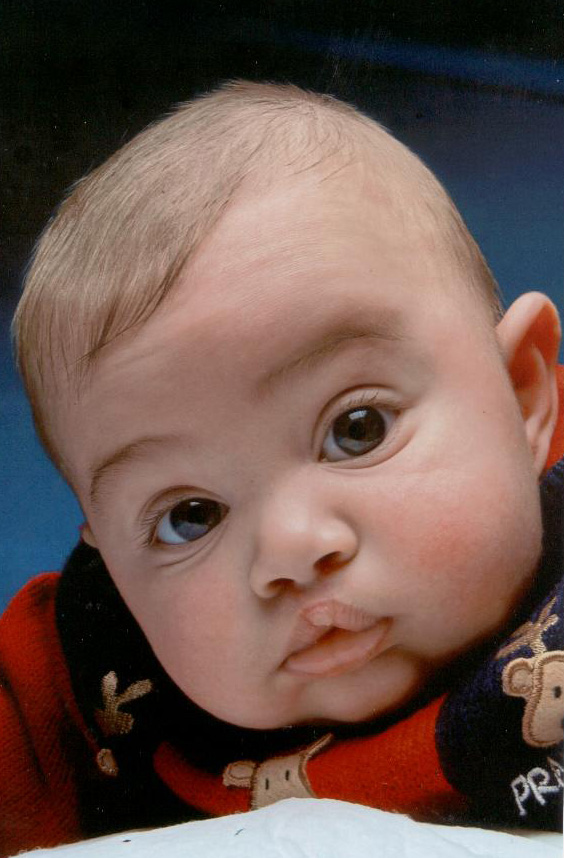
Stage Three is by its very nature a paradox. It’s the most grueling but at the same time, it’s the most fulfilling. Now that I have a 6 month old son--who is always happy, loves to play and perhaps a bit rotund--I can appreciate Stage Three more fully. Sure it’s still frightening but that’s all apart of the magic that is parenthood. Yep, my professor's postulate though somewhat antiseptic couldn't be more right.

Here is to a happy and prosperous 2006. Don't forget the leap second

Tuesday, December 27, 2005

The sun sets on an era


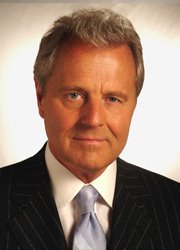
An era of Cleveland television has come to and end. Tim Taylor, 6 and 10PM news anchor at WJW FOX 8 for 28 years retired on December 23rd. You can feel an emptiness in the newsroom in the wake of his departure. It sounds melodramatic but its true. Maybe its because I remember watching Taylor growing up in Cleveland and for the last several years, I had the distinct honor of working with him. I vividly remember as a young child hearing his voice from the family room TV during the evening news as we cleaned up the kitchen after dinner. He was the symbol of credibility in this environment of "entertainment news" the likes that will never be duplicated. The newsroom will be different without him.

Quick story. I remember last summer while going through some old weather records from Dick Goddard's archive when I came across a notation that Goddard made from 1991. The exact date excapes me. At any rate, the notation wasn't about some freak meteorlogical event as one might think. The note simply read in red ink:

FLY GOES IN TIM'S HAIR AND DOESN'T COME OUT

Now that's good stuff from yester-year! But I digress...

The nature of television news has changed dramatically over the last decade and continues to change. Unfortunately, the era of "REAL JOURNALISM" most would agree is drawing to a close as "ENTERTAINMENT NEWS" replaces it. As the Tim Taylors and Tom Browkaws of the world retire, the era of "REAL and CREDIBLE JOURNALISM" seems to be retiring with them. I just hope that I'm wrong.

Tuesday, December 20, 2005

Worthless TV

Tuesday, December 20, 2005

Worthless TV

The time that I have to watch TV is very scarce and precious since, being a parent, you’re occupied with more important things such as the development of your child.

The times when I can take a break and brainlessly flip through the endless channels are relaxing to say the least. However, last week I ran across a show that I despised when it was on network TV and seeing it again in reruns reaffirmed that notion.

This show is Full House. Can someone please explain to me how the show Full House stayed on the air for 9 seasons? One would argue that it has the "wholesome family" motif where regardless of what befalls them, all is fine and dandy at the end of the half hour. Fine. Point well-taken. I'll even admit that happy endings give me a good feeling most of the time. However, 192 of them are just too many "everything-is-back-to-being-perfect" scenarios for my taste.

So the next time you’re flipping through the channels and you come across an old episode of Full House, do yourself a favor and blow right by it. Even if you feel yourself being drawn in while asking yourself the question, "I forgot how young the Olsen Twins actually were in this show", its best for the good of all that you continue to channel-surf and maybe land on something more innocuous such as the Food Network or a rerun of the Jeffersons.

Then again, John Stamos' hair, however, does stand the test of time. That in itself might be worth the price of admission.

Sunday, December 18, 2005

Winter's Wrath in late Autumn

December 18, 2005

Winter's Wrath in late Autumn

So much for the Global Warming pundits' talk of polar icecaps melting, my backyard is officially a glacier and it’s getting thicker!

The first 18 days of December in Northeastern Ohio have been the 2nd coldest EVER! We're talking temperature records that have been on the record books since 1871 which, by the way was during a mini-cold period in climate history but I digress.

Why is it so cold so early? Here's a little climate background and some meteorology to hopefully explain this somewhat freak early winter:

The atmosphere circulates around the planet in a wave-like fashion. One of the components of these waves is called Rossby Waves. Rossby Waves are waves formed due to Coriolis Force as air circulates around the planet at different latitudes. Changes in--yes, a scary weather term: Vorticity--(one of the most fundamental driving forces in planetary atmospheric motion which causes the overall weather patterns) change the dynamics of the wave. (If you’re wondering--and I know most of you are--what the equations that are used to describe the changes in vorticity and ultimately weather patterns, check this out.

Maybe all of you will think twice before mocking the local television weather guy or gal. We had to study and memorize this stuff! (Thank you Dr. Pasken)

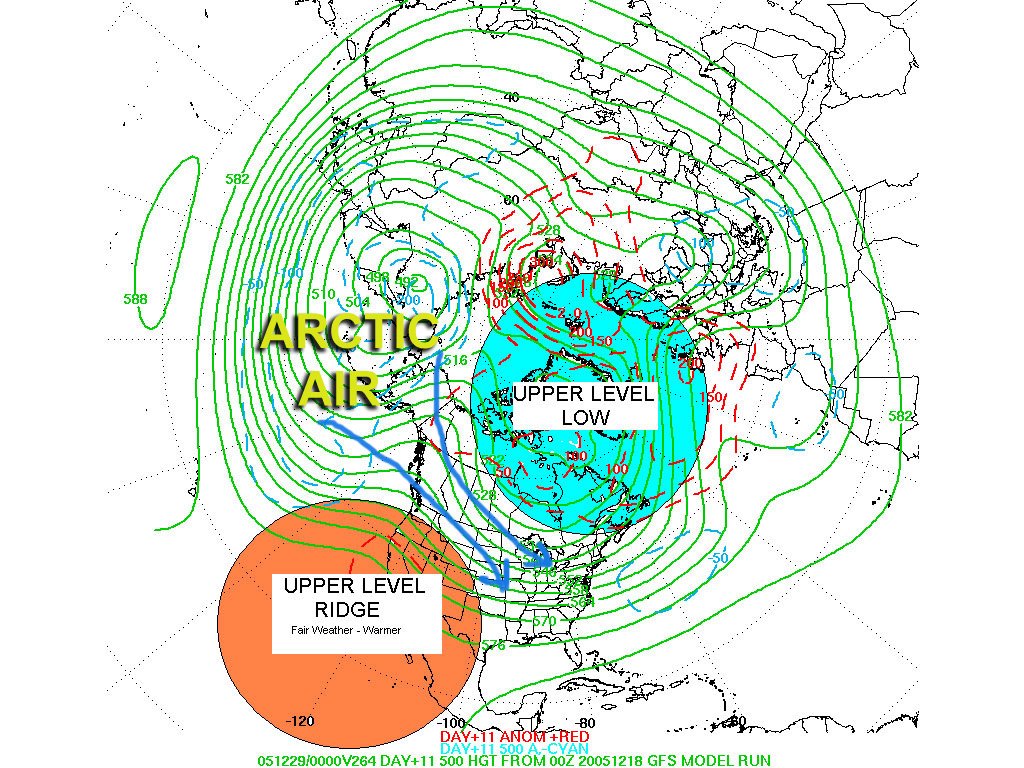
Anyway, these Rossby Waves are not uniform so they tend to fluctuate in intensity as they circle the northern hemisphere because of changes in vorticity. Often times, a Rossby Wave will develop an upper level low over Hudson Bay in Canada while a strong high pressure cell becomes entrenched over the North Atlantic.

This upper level high (at an altitude of 18,000 feet) often migrates a little to the west or to the east throughout the year.
This fluctuation in the position of this "North Atlantic High" directly effects how much arctic air is funneled down over the eastern 2/3rds of the US. The dynamic fluctuation of this high pressure cell over the north Atlantic is called the North Atlantic Oscillation or the NAO.

If the NAO is positive, the weather across the eastern US and Great Lakes tend to be warmer than normal with below normal wide-scale precipitation. If its negative, than the floodgates open from the north and the eastern US gets blasted with arctic air, lake effect snow and a better chance of nor-easters forming shifting the ridge to the west.


Right now, as of this writing (December 18, 2005), we are in a negative phase of the NAO. This would explain why the average high temperature for the first 18 days of December has been 25 degrees whereas last year it was 42!

Incidentally, The NAO also exhibits significant variability over multiple decades. For example, the negative phase of the NAO dominated the circulation from the mid-1950's through the 1978/79 winter. Those of you who remember those winters back in the late 70s, the NAO was the reason for it.

The near record cold notwithstanding, ski resorts are reporting some of the best business this early in the year in quite a long time.

The million dollar question still remains: What is the rest of the winter going to bring? It seems as if the NAO is starting to change toward the positive which would suggest that January will bring less cold air outbreaks. At this point, I welcome a weeks worth of 40+ degree weather. But in this age of supercomputers with weather models containing partial differential equations that would make the most sure-footed mathematics major cringe; there is still no guarantee in weather forecasts. Stay tuned.

Friday, December 16, 2005

Evening with SABS Introduction


I must confess that over the last 6 months, the blog EVENING WITH SABS morphed from one concept to another. Should it be serious views on the world around us? Should it delve into current events or feature discussions on some topic that is "all the rage" like--say, the XBOX 360 or Global Warming or the question of whether the show "Joey" will be back for a third season? After careful deliberation, I've decided to make "EVENING WITH SABS" a blog of random thoughts and insightful observations of the world around me that might not be necessarily mainstream or "hip". Altough the original incarnations of "Evening with SABS" would surely have promised to be insightful in its own way, I believe that this current format will prove to be more useful and more enjoyable to the casual reader and frankly, more fun for me.


So, relax, sit back, enjoy an adult beverage and a cigar (my personal favorite is the Arturo Fuente Rothschild) and get ready for hours of family fun spanning a multitude of genres along with some science sprinkled throughout.


Keyword: INTRODUCTION