Showing posts with label Sports. Show all posts

Monday, November 24, 2008

THE 80s ARE FADING


As a baseball fan from the 1980s, I grew up watching players like Wade Boggs, Joe Carter, Kirby Puckett, Mike Schmidt, Robin Yount, Gary Carter, George Brett, just to name a few.


Now that the 2008 season is in the books, I wanted to look back at the players who are STILL playing who started out playing in the 1980s.


THE LIST, FIRST WITH THE PITCHERS


GREG MADDUX
RANDY JOHNSON
JOHN SMOLTZ
TOM GLAVINE
JAMIE MOYER
KENNY ROGERS
TOM GORDON
KENT MERCKER
RUDY SEANEZ


NOW, POSITION PLAYERS


KEN GRIFFEY
OMAR VIZQUEL


PLAYERS WHO WILL PROBABLY RETIRE OR WON'T BE SIGNED


OMAR VIZQUEL
TOM GORDON
RUDY SEANEZ
KENT MERCKER


NOW, HOW MANY ARE GUARANTEED TO PLAY IN 2009 CONTRACTUALLY

GARY SHEFFIELD


PLAYERS THAT WILL MORE THAN LIKELY SIGN IN 2009


GREG MADDUX
RANDY JOHNSON
TOM GLAVINE
KEN GRIFFEY
JOHN SMOLTZ
JAMIE MOYER


HARD TO BELIEVE THAT 7 PLAYERS COULD BE LEFT FROM THE 1980s BY OPENING DAY 2009

Tuesday, November 11, 2008

THE WORST HITTER EVER

An article from Dugout Central

---------------------------------------------------------------------------

Published by Steve Caimano on November 10, 2008 07:25 am

My assignment is to identify the worst hitter to ever play major league baseball. This is exactly the kind of article nobody wants to write. As soon as you pick a name somebody will argue that the player was a great fielder or that he was a clubhouse leader or an outstanding human being, and you’re just a big fat jerk who couldn’t hit a major league fastball with an oar. All of that might be true, but it doesn’t change the fact that somebody has to be the person who was the worst at every human endeavor. So with the understanding that I am making no judgments on any other aspects of this man’s life other than his ability to hit, let’s identify the worst hitter in history.

The first thing we have to do is identify how long you have to have played to qualify. It certainly isn’t enough to just be historically bad for a few at bats, or even a year or two. No, to be the worst hitter ever you need to have longevity as well as ineptitude. In order to qualify for this "award" a player has to have a minimum of 3,000 plate appearances.

Next comes the harder part: how do we measure "worst"? What I decided was that I would use career OPS+ to whittle the field down, then do a more detailed analysis on this (hopefully) small number of players. I used OPS+ because it’s adjusted for the era in which the player played and their home park and also because it only deals with hitting. The problem with using some of the advanced stats (VORP or Runs Created) is that these include stolen bases and I didn’t want to muddy the waters.

So I went to baseball-reference.com and used the "Play Index" to give me a list of the players with at least 3,000 plate appearances and a career OPS+ less than 75 (the average OPS+ is 100). What I found shocked me. There would be no need for a detailed analysis of a group of closely matched players for the title of "Worst Hitter Ever". No, the answer was clear, and his name is Bill Bergen.

Bill Bergen was a catcher for the Cincinnati Reds and Brooklyn Superbas/Dodgers from 1901 to 1911. He played in a total of 947 games and had 3,028 at bats. His career OPS+ was 21 … that’s right, 21. The next lowest career OPS+ was the 49 posted by Hal Lanier. Hal Lanier’s lifetime slash stats (AVG/OBP/SLG) were .228/.255/.275. Bill Bergen was a far worse hitter than Hal Lanier. Bill Bergen’s BEST hitting year was 1903 when he went .227/.252/.266, which equates to an OPS+ of 41 and is worse than Lanier’s career numbers. He had four doubles, two triples and seven walks in 207 at bats.

It’s difficult for me, quite frankly, to find words that do justice to how bad those stats are and, again, that was Bergen’s best year. It was the only time in his eleven major league seasons that he managed to hit for an average above .200. In 1909 he hit .139 in 346 at bats. In 1911, his final year, he hit .132. He had four extra base hits and a slugging percentage of .154. His OPS+ was -1. I didn’t know it was possible to have a negative OPS.

CAREER STATS:

AB: 3,028
HITS: 512
2B: 45
3B: 21
HR: 2
AVG: .171
OBP: .194
SLG: .201

Saturday, September 27, 2008

Its Time To Hang It Up

Over the summer while playing a home baseball game, I was chatting with one of the umpires while the grounds crew was getting the field ready for play after a brief rain shower.


This guy was a throw-back; an old school guy who looked like he lives life with a cigarette in one hand and a beer in the other. His face was weathered with deep wrinkles from years in the sun. His character, which didn't take but more than 10 seconds to discern, was a direct reflection of his appearance--rough and to the point. He was probably 60 or 65 but looked easily twenty years older.


His words were hidden with insight from an "everyone can kiss my ass" point of view. Each thought was beautifully ochestrated with an incredibly abrasive tone that made you wonder how he could hold a job. The topic didn't deviate too much from baseball,. Yet, like a carwreck on the roadside, his words sucked you in. I just stood and listended. Granted, it might have all been a show but it didn't matter. It was great entertainment as I passed the time until the start of the game.


Just when it seemed as though the conversation was getting dull, he drops this bomb on me as he walks away:


"...When ever you're ready coach, give me your lineup?"


My throat immediately sunk into my stomach.


What the hell did he say? Did I hear the word "coach" in there somewhere?


My dad was a coach not me. Nothing against my dad or coaches but I wasn't a coach.


This guy really had no idea that I was a player. His gruff nature wasn't a show; the oldtimer ump just plain didn't give a damn. Didn't he remember that I had three hits in the first game and pitched two innings...the game that he was "UMPIRING" behind the plate?


Needless to say, I was pissed. I promptly went oh for four with two strikeouts in the second game due to his slander. Although his intension wasn't to berate me, the fact that he referred to me as "coach", while having some merit, was very unsettling. As far as I was concerned, the word was in lights above my head for everyone to see! I felt like an aged Connie Mack standing on the top step of the dugout after managing for 50 years. The whole concept really bothered me.


It didn't hit me until later that day that maybe this guy was onto something. Was I getting too old, too slow to play at this level? I still contribute and my hitting is fairly consistant.


It finally hit me while driving a few nights later from another game. I really wasn't having as much fun as I used to. Maybe it was the fact that I didn't play well the game before. Maybe this will pass and I'll feel different tomorrow. No, this is more than that. I couldn't concentrate on the game like I could in the past. Fastballs seem a bit faster. I wasn't as fluid on my feet. The game itself was speeding up because my reactions are slowing down. Maybe the title of "coach"DID fit me more than "PLAYER".


All of these thoughts raced through my mind on that drive home. Yet my conclusion remained the same.


So after 28 summers playing baseball counting high school and college, its time to walk away.


My wife asked me if I was sure? She kept telling me that I didn't have to quit. I told her that this season would be my last; my decision wouldn't change. It was final.


My son will be four next summer. Tee-ball is around the corner for him. Its time to be the dad that teaching young kids how to hit and field ground balls. I still have the first picture of my dad coaching me in my first year in tee-ball. I can't wait for my first picture with my son during his first year playing ball.


Will coaching take some getting used to? Sure.


The feeling you get after getting a basehit up-the-middle on a 0-2 fastball middle-of-the-plate-in, off of the meat of the bat when the score is tied in the bottom of the ninth is something that you only experience a few times and you NEVER forget it. Coaching my son will feel like same experience only it'll happen each day.


All it took was one word for me to realize that it was time to move on and it came from a grizzled umpire who smokes two packs a day:

COACH

Monday, July 21, 2008

Baseball Records Becoming A Rare Commodity

This past weekend as I sifted through the Friday box scores comparing player stats from other years, something stood out as I checked career totals and the age of the player. Aside from a few standout players, career offensive records will become rarer and rarer in the next 10 years. Let me explain:

I took a list of career leaders in 3 offensive categories, homeruns, runs and hits. I only listed players who are at least 30 years old and who were relatively high on the all-time list which for current players is around 250th or so. Its a shorter list than you think which will be self-explanatory once you see it. Each row in the list shows the all-time rank, name of the player, age and the number of hits, runs, etc.

For comparitative purposes, I also placed a few players who are in their late 20s and have played long enough (at least 7 years) with strong enough numbers to warrant consideration as all-time record setters if projected out over the next decade. Projected is the key word here and can be dangerous as it does not take into account a down year or injuries.

The bold-faced names are players that probably won't retire in the next 2 to 3 years. This eliminates a significant number of players who, although rank high on the list, won't have enough time given their age to make a run at any records.


RUNS

46 K. GRIFFEY 38 1575
48 SHEFFIELD 39 1558
54 A-ROD 32 1530
67 F-THOMAS 40 1486
79 JETER 34 1411
83 L.GONZO 40 1400
87 M-RAM 36 1384
90 THOME 37 1371
99 OMAR 41 1345
101 C.JONES 36 1340
108 J.DAMON 34 1321
115 J. KENT 40 1231
416 A.PUJOLS 28 888


HITS

68 GRIFFEY 2615
69 OMAR 2615
79 L. GONZO 2552
80 SHEFFIELD 2550
82 I-ROD 2544
99 FTHOMAS 2448
103 JETER 2422
108 J. KENT 2387
132 A-ROD 2304
138 M-RAM 2281
141 G-ANDERSON 2268
164 C.JONES 2209
172 J DAMON 2180
220. VLAD GUERRER0 2070 (32)
546 J. PIERRE 1497 (30)
575 A. BELTRE 1487 (29)
640 A.PUJOLS 1421 (28)
704 J. ROLLINS 1354 (29)


RBI

19 GRIFFEY 1730
21 FRANK THOMAS 1701
25 M-RAM 1652
33 SHEFFIELD 1588
43 A-ROD 1535
49 J.KENT 1488
57 THOME 1431
63 GONZO 1417
67 DELGADO (36) 1404
327 PUJOLS (28) 903
416 A BELTRE 29) 813
417 A-RAM (30) 813
692 A. DUNN (28) 613
702 V. WELLS (29) 608


HOMERUNS

6 GRIFFEY 603
14 A-ROD 535
16 THOME 523
19 THOMAS 520
23 M-RAM 506
27 SHEFFIELD 485
34 DELGADO 446
43 C.JONES 403
53 J. GIAMBI 382
59 VLAD 378
64 J. KENT 374
65 EDMONDS 371
67 A. JONES 370
77 GONZO 351
88 ALOU 332
105 HELTON (34) 304
114 SEXSON (33) 304
117 PUJOLS (28) 300
122 GLAUS (31) 292
123 I-ROD (36) 292
133 J. DYE (34) 285
134 P. KONERKO (32) 285


Taking out the players who more than likely won't be in baseball in 2011, the list is narrowed down to this:

RUNS

54 A-ROD 32 1530
79 JETER 34 1411
87 M-RAM 36 1384
101 C.JONES 36 1340
108 J.DAMON 34 1321
416 A.PUJOLS 28 888

HITS

103 JETER 2422
132 A-ROD 2304
138 M-RAM 2281
141 G-ANDERSON 2268
164 C.JONES 2209
172 J DAMON 2180
220. VLAD GUERRERO 2070 (32)
546 J. PIERRE 1497 (30)
575 A. BELTRE 1487 (29)
640 A.PUJOLS 1421 (28)
704 J. ROLLINS 1354 (29)

RBI

25 M-RAM 1652
43 A-ROD 1535
327 PUJOLS (28) 903
416 A BELTRE 29) 813
417 A-RAM (30) 813
692 A. DUNN (28) 613
702 V. WELLS (29) 608

HOMERUNS

14 A-ROD 535
23 M-RAM 506
43 C.JONES 403
59 VLAD 378
105 HELTON (34) 304
114 SEXSON (33) 304
117 PUJOLS (28) 300
122 GLAUS (31) 292
133 J. DYE (34) 285
134 P. KONERKO (32) 285

Now, taking out the players who have been injury prone over the last few years and who have had a significant decline in performance in recent years (Todd Helton), you now get this. The highlighted players are in their 30s and have at least 1300 runs, 2000 hits, 1500 RBI or 500 homeruns (Pujols and Vlad Guerrero are highlighted due to their young age and consistant homerun production)

Pretty short list overall when your talking about players cracking the top 10 or 15 in each category.

RUNS

54 A-ROD (32) 1530
79 JETER (34) 1411
87 M-RAM (36) 1384
416 A.PUJOLS (28) 888

HITS

103 JETER (34) 2422
132 A-ROD (32) 2304
138 M-RAM (36) 2281
220. VLAD GUERRER0 2070 (32)
546 J. PIERRE 1497 (30)
575 A. BELTRE 1487 (29)
640 A.PUJOLS 1421 (28)
704 J. ROLLINS 1354 (29)

RBI

25 M-RAM (36) 1652
43 A-ROD (32) 1535
327 PUJOLS (28) 903
416 A BELTRE 29) 813
417 A-RAM (30) 813
692 A. DUNN (28) 613
702 V. WELLS (29) 608

HOMERUNS

14 A-ROD (32) 535
23 M-RAM (36) 506

59 VLAD (32) 378
105 HELTON (34) 304
117 PUJOLS (28) 300
122 GLAUS (31) 292
133 J. DYE (34) 285
134 P. KONERKO (32) 285

After several run-throughs at filtering out aged, injury prone, inconsistant players in the list, we get this final list.

RUNS

54 A-ROD 32 1530
79 JETER 34 1411
87 M-RAM 36 1384

HITS

103 JETER 2422
132 A-ROD 2304
138 M-RAM 2281
220. VLAD GUERRER0 2070 (32)


RBI

25 M-RAM 1652
43 A-ROD 1535


HOMERUNS

14 A-ROD 535
23 M-RAM 506

59 VLAD 378
117 PUJOLS (28) 300


The bottom line:

Only Jeter and A-Rod will have a legitimate shot at the TOP 10 in RUNS SCORED.
Only Jeter, A-Rod and Vlad Guerrero have a shot at 3000 HITS.
Only Manny and A-Rod have a shot at 2000 RBI
Only Vlad Guerrero and Pujols have a shot at 500 Homeruns in the next 7 to 10 years.

Beyond this, we are talking close to 2020 when any other all-time records have a real chance at falling.

Wednesday, July 16, 2008

Remembering 10 cent Beer Night at Cleveland Stadium


It was on that fateful night on June 4, 1974 when the geniuses in the Cleveland Indians Promotional Department decided that dime beer night with no limit was a good idea. A guy I work with was there as a kid but left before the riot ensued. After players were hit with chairs, batteries and anything else that wasn't bolted down, the umpires finally called the game.


Read a great narrative of the night on Page 2 of espn.com.


These pictures from the Cleveland Plain Dealer are priceless.


The guy in the middle is pretty imtimidating with those glasses.

I think I saw this guy tailgating at a Browns game.

Monday, June 30, 2008

Baseball Offense WAY Down in '08

Chalk it up to the steroid testing policy which wasn't beefed up--pardon the pun--until 2005 with worthwhile penalties (A first positive test resulted in a suspension of 10 games, a second positive test resulted in a suspension of 30 games, the third positive test resulted in a suspension of 60 games, the fourth positive test resulted in a suspension of one full year. Later that year, the penalties were changed to: first positive test, 50-game suspension; second positive test , game suspension, third positive test would result in a lifetime suspension from MLB), offense in baseball in 2008 has been noticably lower than in recent years.


Projecting runs scored for this year (22,192 runs) through the end of the season would yield the lowest total since 1997.


Projecting homerun output this year through game 162 would give a total of 4788 homeruns. The lowest total since 1997.


The most glaring stat is the historical ERA numbers since 1996.


While ERA has come down since it's peak in 2000, its continued to oscillate up and down somewhat since. However, the first sharp drop in ERA occurred in 2001, four seasons before the first real strict steroid penalties took effect and 2 years before testing began. Is this a result of steroid testing or just a function of the randomness of baseball?


So far, 2008 ERA numbers are on pace for the lowest level since the second expansion era began in 1993, that's 16 seasons.


While homerun numbers are down 8% from 2006 to 2007 and a projected 3% from 2007 to 2008, Doubles are up 4% since 2003. What does this mean? Either steroid testing is working in that performance enhancing drugs aren't as prevalent as they were 10 years ago and/or the lack of pitching talent has weeded itself out of the big leagues since its dillusion due to expansion in the early and mid 1990s. Give it another couple of seasons to see if a trend develops from homerun hitting to doubles hitting and much lower ERAs.

Sunday, June 22, 2008

Oldest Player to Play with Babe Ruth Turns 100

Baseball is a game of big, round, meaningful numbers. Bill Werber knows about that: He got exactly 200 hits in the 1934 season and here he is 74 years later, still around to talk about it.

Werber, the oldest living major leaguer, turns 100 years old on Friday.

"It appears," he said from a senior housing facility in North Carolina, "that I'm going to live past 100."

Werber played with Babe Ruth and Lou Gehrig, with Jimmie Foxx and many others. He played for Connie Mack. He played on a world championship team with the 1940 Cincinnati Reds. He went fishing with Ted Williams. He was the first player ever to take an at-bat in a televised major league game. He was the first All-America basketball player produced by Duke University. And, even at 100, he can still remember almost all of it.

"That's because I'm intelligent," he said.

Bill Werber (sliding) played in the major leagues for 11 seasons, and won a World Series with the Cincinnati Reds in 1940.

Werber's career began in 1930, and ended in 1942. He played mostly third base for the Yankees, Red Sox, A's, Reds and Giants, hitting .271 with 1,363 hits, 78 home runs and 215 steals. In 1934 for the Red Sox, he batted .321 with 40 steals. He played the final seven years of his career in pain due to a damaged toe, but he never complains about that. On a daily basis the memories he collected from his 13-year career bring a smile to his face.

And no one makes him smile more than the mention of Babe Ruth.

"I was very fond of the big monster," Werber said. "He knew he was the adopted son of a bar owner named Ruth, he never knew his own mom and dad. He was kind to children. He signed autographs by the thousands. Kids would walk all over his white shoes and tan pants. It didn't matter. He would visit hospitals, and he'd never take a newspaper man or cameraman with him. I got a nice letter recently from his granddaughter. She sent me pictures."

Werber played two years with the Yankees and he and Ruth became close friends.

"Babe was a good bridge player," he said. "He knew all about it. [Yankee catcher Bill] Dickey and I were partners against Babe and Gehrig. We'd play on the train for 2½ hours. Babe used to give what he call "phonky" bids to irritate Gehrig. He liked to irritate Gehrig."

And teammates liked to irritate Ruth.

"They used to play tricks on the Babe," Werber said. "They'd nail his shoes to the floor. Or, they'd take the eyelets out of his shirt so his shirt would fly open. Babe made $80,000 a year. He'd get a check every two weeks for $7,500. Mark Roth, the secretary of our club, would put the pay envelopes on each player's stool in the locker room. He'd use scissors to open each envelope. Guys would take Babe's check out of the envelope and tape it on the mirror in the bathroom in the clubhouse. Guys would be combing their hair, or putting talcum in their jock, and there was Babe's check looking right at them. He'd leave it up there all day. When everyone was done, he'd take it down, and go on his way."

Werber never played with Ted Williams, but he knew him.

"I liked Ted," Werber said. "I told him a ghost story once on a train ride. It was a good ghost story. We sat Ted in a certain place so he could hear it. We had two other guys, Tom Connelly and Roger Cramer, placed strategically around Ted. At first, he didn't buy into it, but then he did. At the climax of the story, I yelled, 'I am the 12th man!', my eyes were dilated, my fingers were outstretched. Ted jumped in the air, then he beat me over the head."

Werber also visited Williams' home more than once.

"Ted was funny," he said. "We had dinner at his house after fishing with him one day in the Florida Keys. Ted had had a few too many martinis. We were with our friend, Dick Locker. Dick told Ted, 'You're going to have to talk a little louder to Bill, he's deaf.' Well, all through dinner, Ted thought that it was Mrs. Werber who was deaf. So, every time that Ted would say something, he'd lean across the table to Mrs. Werber and say, 'Did you hear what I said?' And Mrs. Werber would say, 'Yes, I heard what you said, Ted.'"

Werber said the highlight of his career was playing for the world champion Reds in 1940. Not only was that team a champion, but, Werber said, that team knew how to have fun.


"We had a second baseman named [Lonnie] Frey who had liver spots all over him," Werber said. "So I started calling him, The Leopard. He looked like a leopard. And he ran like a leopard. So I started a club on the Reds called The Jungle Club. Frey was the Leopard. I was The Jaguar. Our big first baseman was Frank McCormick. He was the better hitter in the league that year. He told me, 'I want to be in the Jungle Club.' I told Frank, 'But Frank, you don't hustle enough to be in the Jungle Club.' He said, 'If I hustle for a week, can I be in the club?' I said, 'Maybe if you hustle for a month, you can be in the club.'"

So, we were in Boston, he had a big game, and he took a couple of guys out for beers after the game. He said< 'Did I hustle good enough today?' I said, 'Yes, you did, Frank. We've decided to put you in the Jungle Club.' He said, 'What's my nickname?' I said, 'We have a suitable name. You'll be The Hippopotamus.' He said, 'I don't want to be The Hippopotamus. I want to be The Wildcat.' I said, 'Frank, you are a wildcat.' He ran out in the hall and said, 'I'm in the Jungle Club. I'm The Wildcat!' Things like that really help a ballclub play better, playing kid games."

It was with the 1940 Reds that Werber led off in the first game on television in baseball history.

"I didn't even know about it until four years later," Werber said. "I was walking through the country club where I was a member when this young fellow read out of a book of trivia that I was the first batter ever to bat in a televised game. And I didn't even know it."

Werber hasn't watched a game on TV in years.

"I don't watch any baseball anymore," he said. "I stopped watching because of Johnny Damon and, what's his name? Alvarez? … Ramirez? … Yeah, [Manny] Ramirez. He had that long hair thing going down the back of his neck. And Damon had that beard. I wrote a number of polite letters to [commissioner Bud] Selig. I don't believe in being abusive, that won't get you nothing. He wrote me some innocuous letter back. It didn't say anything."

Werber loved his career as a player, and he loved playing basketball at Duke, but being a very smart man, he knew baseball would only last so long. When he retired, he made a second career in his father's line of work: insurance.

"I made a $100,000 salary my first year out of baseball [working at New England Life Insurance]," Werber said. "Hey, that's $20,000 more than Babe Ruth made in his best season."

Bill Werber laughed heartily about that. After 45 minutes on the phone, recalling his favorite stories, Werber took a nap. At 100 years old, and lucid beyond belief, he slept well.

Sunday, August 26, 2007

Random Stuff

Before I forget any longer, my son just went number 2 on the potty for the first time last month. Of course, i got a picture of him showing all of us his excrement.


Forget steroids. Forget HGH. Forget greenies. Did you happen to hear about the ballgame last week between the Orioles and the Rangers? The final was.....30 to 3. This marked the first time in 110 years that a team scored 30 runs in a game. Amazingly, only 4 pitches were used.

Thursday, August 09, 2007

New Homerun Record Holder!


Barry Bonds has done it. He is the new homerun champion....


.....and no one cares.


Of any record in sports, this is at the top of the list. Networks should have broken into programming to air each at bat leading up to it. Bonds should have been on every national morning show talking about the long trek leading to the record. How he was thinking of his dad every step of the way. He should be bombarded with questions with what it feels like to have hit more homeruns than any baseball player in major league baseball's illustrious history. A parade in his honor should be in the works at the end of the season. Kids should be playing ball in their backyards mimicking his swing imagining that they were the ones who were circling the bases on Wednesday night in San Diego at Petco Park at 11:51 E.S.T.


Instead, a cloud of suspicion hovers over this and many of his offensive feats like a perpetual fog.


Let me first begin here: Before I sat down to write this entry, I made a point not to incorporate the words "steroids" or "performance enhancing drugs" at any time aside from this sentence mentioning that I wouldn't do it. So to keep with the promise I made five minutes ago, the "s word" remains off limits.


I don't need to use those words to describe the feeling that I along with other baseball fans are experiencing right now. Whether your a baseball purist or a baseball progressive (whatever you call the opposite of purist), its real tough to get on board with this event that should have "feel good" written all over it. This should make Mark McGwire and Sammy Sosa's chase back in '98 seem like a typical day. Instead, the word "suspicion" is the adjective that encapsulates this achievement. That speaks volumes.


Trust me, I want to embrace this. I really do. I'm the first one to say that the players are not the only ones at fault in this era of "larger" than life players. Team Management, front offices, the players' union, the media and major league baseball from the commissioner on down are equally guilty of looking the other way. Everyone was making tons of money (in the billions according to some estimates), the game was flourishing after the '94 strike, Ripken just broke the consecutive games record and attendance was up. Hell, baseball couldn't have been better back then.


Here we are around ten years later. The homerun record was just broken and its just an afterthought in the media. What a travesty.


I am here to strip away the emotion of it all. Let's look at the history of all 756 homeruns in a vacuum without speculation.


3 Inside the park homers

10 game ending homers

11 grand slams

36 ballparks homered in

71 multi-homer games

157 homers hit at home in San Francisco

375 homers at home, 380 homers away

447 pitchers homered against
Scatter diagram of Bonds' 2006 homers:

Didn't that feel better?

Tuesday, May 29, 2007

Barry Bonds' Homerun Log

In the event that you really want to know who gave up Bonds' 331st homer then this list is for you courtesy of baseball-reference.com. Even if you don't like Bonds as a player, you can still respect the list as it is impressive. It isn't until you reach the bottom that you start to smell a "hint" of steroids and HGH...oops, I mean arthritis creme.


Monday, April 09, 2007

Lake Effect Snow in April Produces Snowout

Lake effect snow is something that I am growing to hate. Hate is a powerful word but it fits here.


On Good Friday, the Cleveland Indians were scheduled to play their home opener. After 2+ hours of snow delays, countless trips across the infield blowing the snow off and thousands of gallons of 2-cycle fuel, the opener was cancelled and rescheduled the next day as a double header. So much for that. The double header was snowed out. So, how about a double header Easter Sunday with another game to be made up later in the year? Nope, another snow out due to the continuous lake effect snow squalls. That makes three consecutive snow outs due to more than 20 inches of snow! Now, the new "home" opener which was pushed to Saturday has been moved to Milwaukee due to horrible field conditions.

What we need now is about a week's worth of 80+ weather. That ain't happening either. Rain is forecasted for Wednesday and Thursday and again on Saturday. At this rate, baseball won't be played in Cleveland until mid-July.

At the bottom are the storm totals since the snow began falling last Wednesday at 5PM. 118 hours of continuous snow.

Tuesday, September 05, 2006

The Rapid Departure of Summer

I just finished a graphic illustrating the 6th named tropical storm of the season named Florence (which resides in the central Atlantic) when it hit me: Summer is basically over! I'm guessing this thought was coalescing inside my cerebral cortex ever since daytime temperatures fell to a pedestrian 73 with heavy cloud cover but it just took a week or so for it to surface.

Whatever the catalyst, September is here and I'm caught in the middle of being distraught at the loss of daylight and afternoon heat with the relaxing feel of cooler nights and mild days coupled with a fountain of colors spanning the entire spectrum which will soon blanket the leaves (due to the absence of chlorophyll) as autumn begins.

Honestly, I love summer but I love autumn even more. It reminds me of splitting wood with my dad, my mom taking all of kids to ball practice after school, playing football in the backyard in Hudson, the smell of the wet leaves on the ground as we raked them up after an afternoon rain, the Browns when they were good.....you know, the good things about the changing of the seasons.

Now the "not so good" things.....

We've already seen the emmergence of those dark, mid-level clouds on more than one occassion which foreshadows not only prolonged overcast days but yes, the return of lake effect snow.

The road construction on the interstates is either finished of winding down. This in and of itself is great but it also signifies the return of colder weather and eventually salt trucks.

The Indians are almost mathematically eliminated from the playoffs.

The Browns have gone through 57 starting Centers and the season hasn't even begun yet.

So unless someone has invented a method of changing the tilt of the earth on it's axis, the warm of summer will soon be a distant memory the leaves will soon be a sea of brilliant colors and the snow will be flying.

I can't wait!

Monday, May 15, 2006

The Anniversary of Perfection

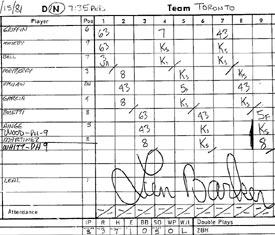
If your not a baseball fan then you might not know what a "Perfect Game" is. Imagine getting every hitter out--all 27 of them. Since 1876 (the start of organized Major League Baseball), there have been more than 350,000 games played, a perfect game has occured only 17 times (0.04%). Of those 17 occurances, only 10 times in the American League since 1901. One of these occurances was on May 15, 1981 at Cleveland Municiple Stadium in front of 7,200 fans (more an 500,000 claim to be there) when Len Barker pitched one of these perfect games.

Now, an owner of a construction company in suburban Cleveland, he reminisces back 25 years ago about this great achievement that happened on the most imperfect of nights.

Below is a picture of the signed scorebook from that night.

Friday, May 05, 2006

A Disturbing Workout

If anyone knows me, they know that I am a big proponent of a healthy lifestyle. I lift weights and do cardio-exercise on a regular basis and eat a good balance of protein, carbohydrates and fats to maximize my energy level. Its a challenge keeping up with the rigors of physical fitness especially now that I am a father with other activities preoccupying my time more than ever. Not that I'm trying to sound like Jack LaLanne, who stays physically active by pulling boats at the young age of 92 but staying in shape is the best thing you can do for yourself. If you are young and one of your food groups is french fries with ranch dressing then your signing your death wish but I digress.

That brings me to this past Monday. I had just finished working out at the community center and was in the process of getting cleaned up in the locker room when all of a sudden, a group of aged men entered the locker room after finishing their "workout". They were all talking about what ailed them. In fact, one guy was commenting how he was pleased that he didn't walk like a duck anymore...whatever that means. But most of the dialogue revolved around retirement, complaints about their "old ladies", their discovery of the internet and how this wasn't around back in the 40s, and on and on and on...

At this point, I felt like a kid at the grown-up table at Christmas dinner greatful that I was there but knew damn well that I didn't fit in. Hell, I was born when these guys were approaching 60!

Then the worst thing that could happen in a locker room full of old men actually happened. As if ordered by some omnipotent force from above, they all disrobed down to NOTHING! No, not down to underwear...down to bare ass!


This is what super-old men should be doing.

You're probably wondering why I looked in the first place. Well, its hard not to when you have six old men with a combined age of 498 walking around the locker room buck-naked taking half steps. Try not looking at a 15 car pileup on the interstate. See, that was my conundrum that fateful day. Believe me. A room of old men with wrinkly, stretched out skin and fat hanging down all over the place was the last image I wanted my eyes to capture and my optic nerve to send to my brain to process.

Oh, the humanity!

This brings me to my "moment de vérité" (moment of truth):

Why are men over the age of 80 working out in the first place?

Honestly, is working out going to change anything at this point? I mean, once you've hit 80, does your doctor all of a sudden tell you "You know, you might want to get on a fitness regimen"? No.

I've never been to my grandmothers' doctor's appointments but I'm fairly certain that the conversations had nothing to do with "pumping iron" or cardiovascular training. Maybe I'm wrong but I don't think this happens.

The operative word in all of this is YOUNG. If your just out of college and you smoke then that isn't good. If your in your 30s and your starting a family and you eat greasy burgers with a few beers 4 times a week, that probably isn't good either. If your in your 40s and 50s (the age when heart attack chances become greater) and your daily exercise consists of flipping through the channels then your not too wise. If your in your 60s and 70s and you do all of the above then your arteries could very well look like my basement plumbing.

In other words, working out when your under the age of 80 is the best thing you can do for yourself. Once you hit 80, what's the point. Yes, I know that you need to stay active at an elderly age but that shouldn't culminate in a trip to the locker room to chat NAKED! Play bingo or hang out at the mall or something. Walk down to the Piercing Pagoda Kiosk or the Orange Julius in the footcourt for exercise. Now I'm scarred for life because six old men decided to dawn their plaid shorts with an "I'm a grandpa" shirt (no doubt bought at Myrtle Beach) topped off with black socks and velcro sneakers to work up a sweat only to strip down and lumber around the locker room letting it all hang out. Why can't some hot chick (or chicks) saunter in with their clothes off?

I can tell you this. When I hit the magical 80--assuming I live that long--I'm taking up smoking, drinking scotch everyday and eating food that has all of that trans-fatty stuff that makes it taste so good. I'm purchasing a recliner and super-big plasma TV (or whatever the high end TV is in the year 2054) and I'm only moving to go to the bathroom assuming that I can still go unassisted. Why? Because what's broke by then ain't going to get much better. Why not have some fun? A friend of mine said he's switching sexual orientations at 85 just for fun. But that's a story for another time.

Today, there are many issues in our society that the president now and future presidents will have to tackle. The high cost of health care, oil prices, the Iraq war just to name a few. However, if I were president, I would make it illegal for men over the age of 80 to be naked in the presense of others. People say television and video games are damaging the minds of our young people. Nope. Catching an unwanted glimpse of a/many naked, flabby old men is definitely at the top of the list!

Monday, April 24, 2006

Interesting Baseball Play: K767


Every once in a while, I will run across a most unorthodox baseball play that catches my eye. This one--K767--which means Strikeout: Leftfielder to Shortstop to Leftfielder is probably the strangest one yet. Here's how it happened:

In the game of April 25, 1970, Tiger pitcher Earl Wilson struck out to end the seventh inning in the Twin Cities. Or so it appeared to everyone except Detroit third base coach Grover Resinger. He saw that Twins catcher Paul Ratliff trapped the pitch in the dirt, did not tag Wilson and rolled the ball to the mound. Resinger told Wilson to start running as most of the Twins entered the dugout. Earl got to first easily and headed for second. Since no one interfered with him, he started for third. By this time, Brant Alyea, who was trotting in from left field, heard Resinger shouting at Wilson. Alyea hustled to the mound but had trouble picking up the ball. Wilson headed for home where Twins Leo Cardenas and Ratliff had returned. Alyea finally picked up the ball and threw to Cardenas, the shortstop. Wilson turned back to third but was tagged out by Alyea for a K767. Rookie catcher Ratliff was charged with an error. After the game, Detroit catcher Bill Freehan said "If Alyea had been hustling, Earl might have made it [home]. Tell him [Alyea] to start coming in and off the field a little quicker." The aftermath of the story is that Wilson pulled a hamstring muscle running the bases and had to leave the game.

Friday, April 07, 2006

Opening Day - The "Official" Start of Summer

Ah, the beginning of the baseball season in Cleveland. The weather has been warm enough to push the tulips through the mulch. The smell of baseball glove leather, overcooked hotdogs, stale beer and freshly manicured grass permiates every ballpark from San Diego to Cleveland to Boston.

Opening day in Cleveland has history unlike most other major league cities in that professional baseball has existed since a few years after the Civil War. So, to celebrate Opening Day, everyone here at "Evening with Sabs" decided that a historical retrospective with some stats would be a great way to illustrate Cleveland professional baseball history. Don't worry. Its pretty straight forward.

Cleveland professional baseball started in 1869 with the first professional game played near the present day E. 38th street in between Scoville and Central Avenues. The team was named the Cleveland Forest Citys after the Forest City Coffee Company. They lost 25-6 to the first professional baseball team the Cincinnati Red Stockings.


Since that year, professional baseball in Cleveland faded in and out of existance as it did in other cities back then. In 1871 and 1872, a Cleveland team also names the Forest Citys was formed but disbanded. Then from 1879 to 1884, the Cleveland Blues played their games at the Kennard Street Park. During that stretch, they won 4 of the 6 opening days. In 1885 and 1886, no professional baseball was played in Cleveland. But in 1887, Cleveland baseball returned again. Named the Spiders, they won 10 of the next 13 opening days through the 1899 season.

In 1900, no Cleveland baseball existed because of the ineptitude of the 1899 Cleveland team which had a record of 20-132, still the worst record of any baseball franchise in baseball history. The team subsequently folded.

Starting in 1901, the new American Leagued was formed and Cleveland baseball was born again. Since then, Cleveland baseball which has been played in 3 stadiums (League Park, Cleveland Stadium and now Jacobs' Field) has won 54 of the 105 opening day games. They score an average of 4 runs in each opening day game. The most scored: 15 in 1997.


The sight of the former League Park. Nothing much is left except the front ticket area which later became a community center. The remaining frontage is in much worse condition than is indicated in this picture (circa 1970s or 80s) Plans are in the works to refurbish the grounds. This was the sight of Babe Ruth's 500th homerun as well as Cy Young's 500th win.


A picture from the last season at Cleveland Stadium from 1993. The new Cleveland Browns Stadium occupies the site as of 1999.
Friday, March 10, 2006

Bonds and Steroids: All but a done deal


Tuesday, news of a new book documenting in great detail Barry Bonds' "alledged" steroid use rose to the top of the sports headlines. So I let it sink in for a few days before commenting on it. Frankly, even after a few days, the story still leaves a bad taste in my mouth.

Since the steroid scandal story broke several years, I've reserved judgment, stood back and let the natural progression of events take care of themselves keeping faith that some piece of information--diamond in the rough, if you will--would shine like a beacon enlightening me to the what REALLY happened. Tuesday, ironically on my birthday, this missing link may have very well surfaced unlocking what most of us suspected for a very long time.

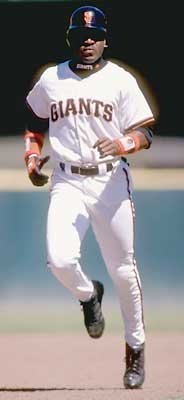
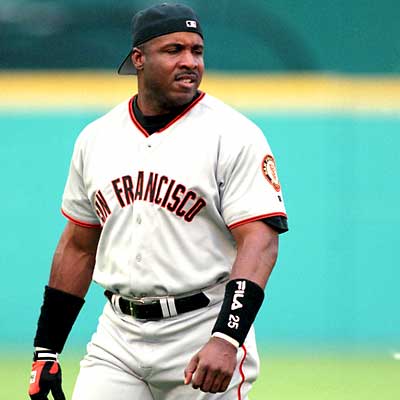
(Picture to the left is Bonds in 1998)

Two authors, Mark Fainaru-Wada and Lance Williams of the San Francisco Chronicle wrote "Game of Shadows" based upon thousands pages of documents and interviews of over 200 people concerning Bonds' steroid usage. (You can click on this Game of Shadows link for more details on how the book came to be) In it, they describe doping schedules, what he took, when and how long among other bombshells. Consider this book--from what I've heard-- to be the Woodward and Berstein/Washington Post Watergate story equivalent.

Stories like this that have potentially longstanding effects on the game of baseball peek my curiosity being a baseball purist of sorts. Invariably, the need for more information in an effort to quench my insayshable curiosity gets the better of me. So I google...google...and google some more hoping for that one article that clarifies everything hopefully tipping my opinion one way or another.

The problem with this method is that there is so much information readily accessible over the internet true AND false. Consequently, the process of filtering out what is hearsay and what is confirmed fact must be efficient and effective. Needless to say, its a monumental task that I hoped would get easier. It hasn't.

Since exerps of the book--billed as the missing link to the Barry Bonds steroids scandal--came out, certain subtopics which paint a broader and more true picture of how this story relates to baseball need to be discussed. Many of these subtopics have been pushed under the radar (Why this happened is more of a discussion of journalism ethics which can be talked about at another time) which does nothing to help us understand the entire story.

Let's go ahead and investigate these misreported and/or left out subtopics individually:

* Contrary to popular belief, a male in his mid 30s can increase his musculature by 10 or even 20 pounds in a relatively short period of time if he works out correctly, rests enough and most of all eats the proper food. Yes, even without steroids you can go from 180 pounds to over 200 pounds in 4 to 6 months! Creatine, an energy source that is found in red meat and other foods can also assist in adding muscular weight. Best of all, it can be purchased at your neighborhood grocery store. I know people who have done this.

(Picture is Bonds in 2000)

* The increase in overall offense in Major League Baseball since 1995 has been driven mostly on three factors:

Diluted pitching due to league expansion in 1993 and 1998, smaller ballparks (rarely do you see an outfield fence more than 365 feet in the power alleys) and more tightly wound baseballs. One of the networks did a story a few years ago at the Rawlings Baseball Facility. What do you kno, the room that wound the baseballs was off limits to the reporters. Hmmm. They claim that the balls are the same but tests since then prove otherwise. Sure, steroids are a factor. No question about it. In some isolated player cases, steroids might be the main factor. But to point to steroids as the main reason for higher homerun totals and more runs scored league wide is stretching it a bit.

(Picture is Bonds in 2001)

* Here's a personal one that I love to debunk: Protein Powder does not come in pill form! I can count at least a half a dozen times where sports writers, who obviously have no knowledge of workout regimens and supplements, talk about "protein pills". Protein comes in powder form and, as of 2006, its great for you!

Anyway, back to the book.

If what the authors say is true in their outlining of Bonds' steroid use from 1998 to 2003, then its fairly safe to say that many other ballplayers could have been on similar doping regimens injecting whatever chemical they thought would give them an advantage. Scary thought when you consider that 7% of all ballplayers tested positive in the first year of testing back in 2003. Who knows how many players were using performance enhancing drugs in the 1990s or earlier.

Is taking steroid in baseball prior to 2003 considered cheating? Some people say no because baseball didn't test for performance enhancing drugs or anything else for that mater. In effect, baseball had no problem with these substances or else they would have been banned a long time ago. In a twisted sense, baseball--although not officially--gave their blessing. "Take whatever you want" was the non-verbal communication from MLB and the Player's Union. Therefore, as many people conclude, it wasn't an unfair advantage because any player could "juice up" without any recourse from MLB.
One other aspect to ponder: Many players back in the 1960s and 70s took "greenies" --stimulants-- to get themselves "up" for a game. Those are considered performance enhancing yet no one has made an agrument for inserting astericks next to players of decades before. By the way, testing will start for the first time for amphetamines in 2006, more than 40 years removed from their first alledged use.

Although MLB didn't test for steroids of other drugs at that time, it is a felony to obtain without a prescription or distribute steroids and has been since 1991. Do you fault the players for taking advantage of the non-testing era knowing that it was illegal? Many athletes don't care about the future ramifications of these substances. These guys are "wired" differently that the rest of us mortals. Anything to get an advantage regardless of the effects to the body; many of they don't care.

Beyond the physical reprecussions, the ethical implications are far greater and can't be ignored. While MLB didn't test for these substances which are illegal according to federal law, players who took these drugs did so with complete disregard for the game itself and all it represents past, present and future. It is this ethical pedestal that these steroid using players should be measured not the poor decisions made by corporate power politicians who represent the owners and the player's union.

Here's an aside about baseball cheating: Its existed in baseball since its inception. No argument here. Whether cheating manifests itself in stealing signs or applying a foreign substance to the baseball in order to change its trajectory players are looking for an advantage and will always will. But consuming artificial chemical substances that don't occur naturally which are illegal in an effort to enhance your body beyond what it is designed to do can't even be compared to Joe Neikro's scuffing-the-ball-with-a-nail-file incident.

Who do we blame for this steroid mess? Many blame the players and want all statistics marked with an asterisk who played from 1995 to 2003. The problem with that is we don't know was "juicing" and who wasn't because no testing existed prior to 2003. Sure, we have our suspicions. But how can we penalize players who earned their numbers the right way with proper workouts and supplementation? The fact is there are players who were using steroids during this period but we will never know with one hundred percent certainty who they were. Frankly, the stats should speak for themselves and left alone. The court of baseball public opinion with its deep historical tradition will be far more critical and damming than a simple "*" next to a player's name.

Many blame the owners. The argument is how could team owners and management not know what was going on. Its foolhardy to think that they had no knowledge. Ticket sales soared during the Cal Ripken games played record chase right after the strike of 1994/early 1995. Rather than inflict another black eye on baseball with a steroid scandal, owners just ignored the problem. Fans were coming back to the game, the sport was being re-energized and the owners were adding beaucoup jack to their wallets. Why stir up steroid talk and upset the applecart?

Many blame the Player's Union. Same argument applies here that applies to the owners. How could they not know? Many players were growing at an alarming rate and so was the frequency of injuries due to many players' bodies breaking down due to the increased muscle mass. Players were having career years offensively and their pay reflected it. From 1989 to 1995, players' salaries jumped 100%; salaries jumped another 50% from 1995 to 2000. The union was in the driver's seat. Player's salaries were going up and most of all, the strongest union on the planet--as some have described it--was as strong as ever. So why address a growing drug problem when it will only weaken their position?

Some blame the commissioner. Back then, Bud Selig was in a quandary. Does he officially bring steroids to the attention of the owners and player's union at the risk of starting another labor war? Most of all, did he want to deal with the public relations nightmare that it would create knowing it would continue to build eventually leading to a fracture that might not be repairable given the delicate state of most baseball fans after the strike? In baseball, the commissioners does not have the power that Paul Tagliabue has in the NFL or David Stern commands in the NBA. So, his hands were tied. After al, baseball was on the road to recovery so like dirt on the kitchen floor, the topic of steroid abuse by baseball higherups was pushed under the rug hoping that no one would notice.

Fast-forward to 2003. BALCO (company involved in creating designer steroids) was in hot water with the Feds, players were called to testify before a grand jury, steroid testing was finally established in an agreement between the union and the owners, congress became involved in 2005 and above all of this, a man at the heart of the steroid universe Barry Bonds was closing in on the most revered of all sports records: THE HOMERUN TITLE. As ESPN writer Gene Wojciechowsk said in a recent article, "...Bonds allegedly chose home runs over ethics."

Two weeks into spring training, this "super-tell-all" book comes out describing everything drug-related Barry Bonds has done since 1998. Whatever the fallout after the book is released, several events must happen: Baseball must own up to their mishandling of the entire steroid mess over the last 10 years. Bud Selig on down the line must take command of the situation and launch a full investigation similar to the Pete Rose gambling issue. I do not envy Bud Selig. He'll be walking a thin line between his extracting and subsequent handling of the truth of steroids past and present and the backlash of any recognition of Bonds' possible breaking of the most celebrated statistic in all of sports.

Most of all, Barry Bonds must come clean with baseball and its fans. He should admit to what he did and finish out the season with the scandal hanging over his head. He's on the verge of breaking the most hallowed mark in sports--the homerun record--which cannot be tainted by scandal. More significant than the players' union or the owners, the homerun record's very nature by its elevated status represents the game far deeper than any individual who might break it. Any link to the record by any individual or individuals whether against the formal rules of baseball or not should be removed in order to preserve the sacredness of the record. Its just a shame that baseball from the commissioner on down the line through ignoring the steroids problem created an even bigger problem that will take many years to dismantle.

As for Bonds' legacy, Gene Wojciechowski wrote, "The tragedy of it all is that Bonds didn't need the alleged chemical boost. His legacy was secure. His Hall of Fame plaque was a done deal. It didn't matter if we thought he was a jerk because his statistics were so overpowering. No longer."

Monday, March 06, 2006

Is it ALWAYS the wealthiest team who wins?

Spring training is in full swing and the debate concerning the "haves" and the "have nots" is heating up again. In other words, is it the Yankees who always win or do other less fiancially flexible teams have similar opportunities in October? Consider these payroll rank statistics when comparing them to regular season wins of teams in the postseason.


The World Series Champions are boxed in red. You can see that since the Yankees World Series win six years, three of the next five World Series Champions were not one of the top ten teams in payroll. Granted, the Yankees have money to spend no question. But it hasn't paid off in the last six years. In fact, the disparity between the Yankees payroll wise and the World Series winner has continued to grow since 2001. The difference between the Arizona Diamondbacks and the Yankees was $27 million in 2001. In 2005, the difference between the Yankees and the Chicago Whitesox was $133 million.

Thus, teams are doing more with less and its culminating in championships.

Friday, January 20, 2006

Spring Training Around the Corner


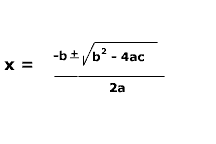
February 21st is the voluntary reporting date for all position Major League Baseball players; a sure sign that winter is approaching its demise. Very soon, I will rank the top 5 players as each position for the upcoming 2005 season using a highly mathematical, scientifically complex, purely esoteric top-shelf method that is yet to be topped in scouting circles. All I will say about this method is that the Quadratic Formula is utilized. Need I say more.

I might use this equation too. I haven't decided yet....


All this for information that 99.9% of the population could care less about...That's the beauty of it!

Tuesday, January 17, 2006

"The Fumble" revisited


Forget the Chicago Cubs and their trophy case vacant of any World Championships since before the Titanic sunk.

Forget the Cincinnati Bengals' post-season drought of more than fifteen years.

Forget the Seattle Seahawks no closer to playoff football than a trip from Los Angeles to New York.

Cleveland sports are, by far more cursed than any other professional sports franchise as indicated by an ESPN article from July 13, 2004 which validates my observation to a tee.

Cleveland is a football town. No question here. Even when the Indians were the powerhouse in the 1990s, the Browns--although defunct as a result of their 11th hour departure to baltimore----were still the talk of the town.

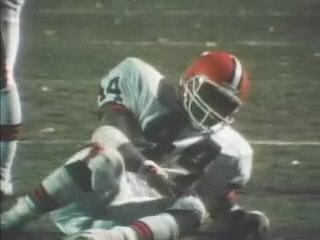
Which brings me to this entry's headline: The Fumble revisited. Today, January 17, 2006 is the 18th anniversary of the "Fumble". This was one of the moments in sports history in Cleveland when Cleveland sports fans had their collective hearts literally ripped out of our bodies right when the taste of a Superbowl trip was as close as the residual Cheedo cheese goo on my fingers that fateful Sunday afternoon.

The fumble is such a pungent memory in the minds of all sportsfans that its now an entry on Wikipedia.com, the free encyclopedia on the World Wide Web for all of the world to see.

I'll spare you the details of the fumble. You can read them yourself. But just remember this day as you get ready for playoff football this weekend.